
Welcome back to a special edition of B is for Book Coach. In these episodes, I’m reading through pieces of You Don’t Get to the Ocean by Accident—the workbook version of the early work I do with all of my authors.
If you want to follow along or jump ahead, pocket-sized copies are available on Amazon, and every Substack subscriber gets a fillable PDF copy as well.
Today, we’re reading from: Using the Table of Content.
Enjoying this space? It takes all of us to create it together! When you become a one-time or ongoing Momentum Partner, two things happen.
First, you get to join a small but growing group of folks who pop in for Office Hours twice a month to sort out their content and travel this journey together.
Second, you add to the Mutual Momentum fund, which helps to bring deeper development support to authors who need more than just space to get started.
You can create a one-time boost of Momentum by clicking the button below, or subscribe to keep the forward movement going for us all.
So when are the three separate layers of the Table of Content (top-level doesn’t matter so much here…not yet) “done” and ready to move into the table? You can probably already see that putting it all side by side could get complicated fast—so don’t start here unless you’re really good at holding your focus to one thing at a time.
If you’re like me and cannot, then play with each list separately until it looks like a decently logical progression from point “hm this book looks interesting” to point “woah, I (see the world/myself/my want) differently now!”
By logical, I mean you’re setting the reader up as Kurt Vonnegut’s Man in a Hole plot. And if you haven’t seen that yet, pause now. Click. Watch. Enjoy. Come back.

Ready?
Ok, so you’re meeting the reader wherever they are—probably “mostly fine, but curious about how things could be better”—then dropping the bottom out from under them with whatever curiosity or problem or pain you’re digging into.
That’ll happen somewhere in the first few chapters: your proposition space. You propose that the world could actually be significantly better, because look at how hard it really is.
After that, you’ve got to build them a ladder and help them climb out of it.
That happens step by step (procedurally, if you will), and too big a leap may mean they can’t stay with you to get out of the hole.
Then, just as their head pops out to blue skies above ground, you help them see how much their perspective has shifted after all that undergroundedness, and they’ve got to reckon with real change they hadn’t quite expected.
If you don’t prepare them for or meet them there in that discomfort, you may lose them altogether.
If you don’t lose them, if you’re able to move them along with you beat for beat of this journey to a new way of thinking or doing or being in the world, then they get the option to participate with you in that way of thinking.
And if you’re really honest with them, (and you should be) that won’t be all blue skies either.
But it’ll be worth it.
And you’ll tell them why.
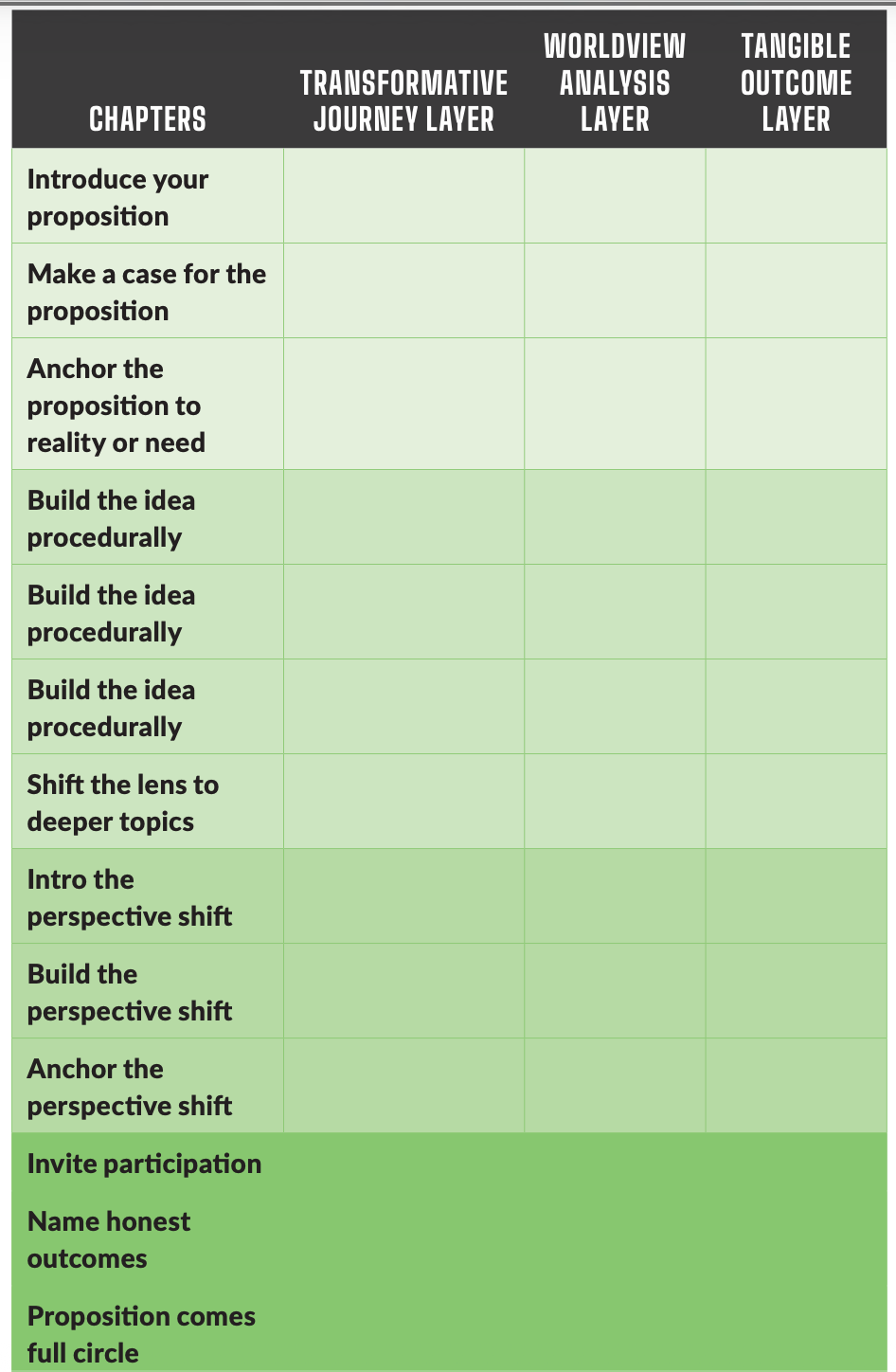
You can see how each point of that process is about keeping the reader with you. It’s not “drop man into a hole and leave him there.” The arc has to come back up.
So making sure each of your lists make decently logical sense in terms of what it’s asking of the reader, what you’ll need to give them along the way, and how far you can realistically take them…that’s what “done” looks like here.
When you have that for all three arcs, plug them in as they are, again without any judgment or panic. Then your table becomes the hypothesis, and the chapter maps become the experimentation space.
Pull the text out from the table to a map.
Run a 5 minute outline for just that chapter.
See if that one row makes sense.
If not, play around with what would make that 5 minute outline make sense.
See what we’re doing here?
One focus at a time, one solution at a time, one experiment at a time.
It’s all good data.
And hey, if at any point you get the itch to just write, step. away. from the spreadsheet.
Go write.
You’ve been unlocked.
Come back if you get stuck.
Chapter Map Template
Note: The idea here is to take what we’ve mapped out into the table and start moving it into another document that feels a little bit more like writing and less like plotting.
Transformative Journey:
Worldview Analysis:
Tangible Outcome:
Reader wants:
But needs:
Outline
1. Hook/Why we care:
2. Topics/What’s in our way:
3. Takeaway:
4. Anchor/Why we’ll believe:
5. Payoff/What’s the invitation:
Totally Ridiculous Example
Transformative Journey: Caught Shining / the Fairy Godmother Story
Worldview Analysis: What makes fairy godmothers pick someone to help
Tangible Outcome: Hope that anyone can be helped
Reader wants: To go to the ball like I did
But needs: To see herself as worthy of the ball
Outline
Hook/Why we care: Fairy Godmother found me and saw something in me and dressed me up and sent me off
Topics/What’s in our way: Why would she do that? What’s a fairy godmother’s M.O. anyway? Why would she do that for me?
Takeaway: My invitation has always been waiting—so has yours
Anchor/Why we’ll believe: Empathy—I need to get more vulnerable here. Probably go deeper into what I was thinking when she first appeared.
Payoff/What’s the invitation: It wasn’t what she gave me, it was how she helped me see myself differently—the way she sees us all.
Hey, thanks for creating this extra space with me today.
To get the rest of the workbook right away, look for You Don’t Get to the Ocean by Accident on Amazon, or subscribe to get a free copy right now.
For this one in particular, i f you would like to send me your lists or tables or spots where you got stuck, you are welcome to do that.
And as always, whenever your book is ready to emerge, the space we made today will be here waiting for you.


